Bad History, Worse Policy by Peter J. Wallison
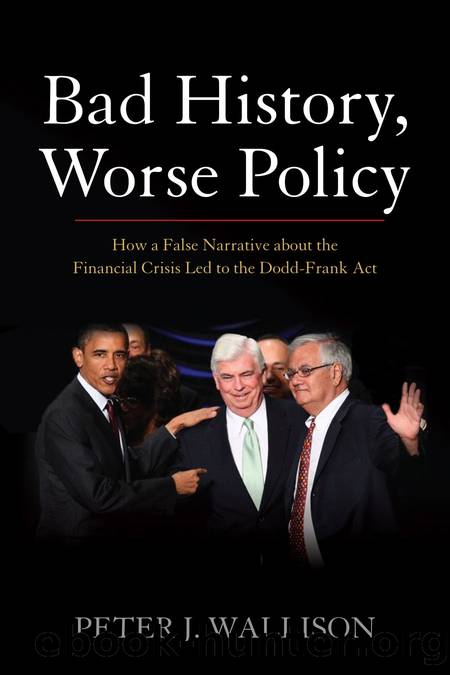
Author:Peter J. Wallison
Language: eng
Format: epub
ISBN: 9780844772400
Publisher: AEI Press
Through interpretations like this, the explanation for why Bear was rescued evolved into a conclusion with far greater policy significance; under the new interpretation of Lehman, all large financial firmsâbecause of their purported interconnectednessâwere inherently a danger to financial-system stability. This provided a rationale for extensive government regulation, since regulation was believed (again, without much evidence) to be effective in reducing the likelihood of a financial institutionâs failure and thus the chances of another financial crisis. Writing in the Journal of Credit Risk, one commentator made this connection explicit: âThis crisisâand the cases of firms like Lehman Brothers and AIG has made clear that certain large, interconnected firms and markets need to be under a more consistent and more conservative regulatory regime. It is not enough to address the potential insolvency of individual institutionsâwe must also ensure the stability of the system itself.â109
That is exactly the approach the Obama administration adopted upon taking office. Through use of the interconnectedness idea, it became possible for the administration to propose a comprehensive system of regulation for the largest nonbank financial firms, going far beyond any regulatory regime ever envisioned in the past. This extensive regulation was justified by arguing that if one of these large firms were to fail it couldâlike Lehmanâcause instability in the financial system, just as Bernanke had argued that the failure of Bear Stearns could have undermined the financial condition of âthousandsâ of its counter-parties. The fact that this never occurred when Lehman failed was ignored. For example, in a statement on September 15, 2009, the anniversary of Lehmanâs bankruptcy, President Barack Obama stated:
While holding the Federal Reserve fully accountable for regulation of the largest, most interconnected firms . . . weâll also require these financial firms to meet stronger capital and liquidity requirements and observe greater constraints on their risky behavior. Thatâs one of the lessons of the past year. The only way to avoid a crisis of this magnitude is to ensure that large firms canât take risks that threaten our entire financial system, and to make sure they have the resources to weather even the worst of economic storms.110
Download
This site does not store any files on its server. We only index and link to content provided by other sites. Please contact the content providers to delete copyright contents if any and email us, we'll remove relevant links or contents immediately.
The Brazilian Economy since the Great Financial Crisis of 20072008 by Philip Arestis Carolina Troncoso Baltar & Daniela Magalhães Prates(302418)
International Integration of the Brazilian Economy by Elias C. Grivoyannis(111312)
The Art of Coaching by Elena Aguilar(53414)
Flexible Working by Dale Gemma;(23319)
How to Stop Living Paycheck to Paycheck by Avery Breyer(19778)
Thinking, Fast and Slow by Kahneman Daniel(12416)
The Acquirer's Multiple: How the Billionaire Contrarians of Deep Value Beat the Market by Tobias Carlisle(12377)
The Radium Girls by Kate Moore(12089)
The Art of Thinking Clearly by Rolf Dobelli(10597)
Hit Refresh by Satya Nadella(9185)
The Compound Effect by Darren Hardy(9052)
Tools of Titans by Timothy Ferriss(8489)
Atomic Habits: Tiny Changes, Remarkable Results by James Clear(8406)
Turbulence by E. J. Noyes(8112)
A Court of Wings and Ruin by Sarah J. Maas(7944)
Change Your Questions, Change Your Life by Marilee Adams(7846)
Nudge - Improving Decisions about Health, Wealth, and Happiness by Thaler Sunstein(7758)
How to Be a Bawse: A Guide to Conquering Life by Lilly Singh(7545)
Win Bigly by Scott Adams(7254)
